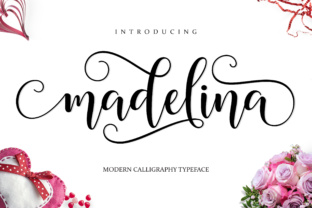
Madelina Script: A Fluid Handwritten Font for Digital Branding
As a UI designer who builds landing pages, SaaS dashboards, and boutique e-commerce experiences, I choose fonts not just for beauty—but for behavior. Madelina Script stands out in my toolkit because it’s a rare handwritten font that performs with intention across digital interfaces. It’s not just decorative; it’s deliberately fluid, with natural entry and exit strokes, subtle contrast, and open counters—traits that translate well to screens when used thoughtfully.
This Script Handwritten typeface feels authentically hand-drawn, yet its rhythm and spacing are engineered for legibility at larger sizes. Unlike many script fonts that collapse into visual noise on mobile or blur on low-DPI displays, Madelina Script maintains clarity in hero headers, email subject lines, and even small banner overlays—provided you respect its role. It’s a display font, not a body font. That distinction is critical: use it for impact, not immersion.
Where Madelina Script Earns Its Place Online
In real-world web design, Madelina Script excels where personality and precision intersect:
- Landing page headlines—especially for creative services, wedding planning tools, or wellness coaching sites—where warmth and human voice matter more than corporate rigidity.
- CTA buttons with short labels (e.g., “Join Us”, “Get Started”, “Yes, I’m In”)—when paired with ample padding and high-contrast backgrounds, the script adds emotional resonance without sacrificing scannability.
- Section dividers and decorative accents—a single word like “Handcrafted” or “Love” set in Madelina Script above a testimonial carousel or product grid creates visual breathing room and reinforces brand tone.
- Logo lockups and favicon text variants—its lowercase ‘m’ and ‘a’ have distinctive shapes ideal for monogramming, and its connected flow supports clean SVG export for responsive logos.
- Digital brand kits—as a primary display typeface alongside a neutral sans serif (like Inter or Manrope), it delivers consistent identity across Figma files, Notion docs, and Shopify theme settings.
Readability & Responsiveness: Practical Boundaries
Madelina Script shines at 36px and up on desktop, and scales cleanly down to 28px on tablet. On mobile, reserve it for headline treatments only—and always test on iOS Safari and Android Chrome. Its thin hairlines can vanish against busy image overlays or dark gradients unless you apply a soft text shadow (text-shadow: 0 1px 2px rgba(0,0,0,0.2)) or a light stroke fallback.
Avoid using it for:
- Body copy, form labels, or navigation menus—its connected letters hinder rapid scanning.
- Small CTAs under 24px—even with letter-spacing adjustments, readability drops sharply.
- Long paragraphs over textured backgrounds—contrast loss compounds quickly.
For dark mode interfaces, pair Madelina Script with off-white (#f8f9fa) or warm ivory (#fdf9f3), never pure white. On light backgrounds, deep charcoal (#2d3748) works better than black for reduced glare and improved tonal harmony.
Smart Pairings for Balanced Web Typography
Madelina Script thrives in contrast. Its organic energy needs grounding—and that means pairing it with a highly legible, neutral companion. My go-to combinations:
- Sans serif pairings: Inter (variable), Manrope, or Poppins for SaaS dashboards and e-commerce banners—clean, modern, and optimized for screen reading.
- Serif pairings: Lora or Playfair Display for editorial blogs, course sales pages, or portfolio case studies—adds sophistication while preserving warmth.
- Avoid other scripts, condensed fonts, or overly geometric sans serifs (like Montserrat Black)—they compete rather than complement.
When building a premium font system for a client, I treat Madelina Script as the “voice” and the sans serif as the “ears”—one speaks, the other listens. That dynamic strengthens hierarchy and guides users intuitively through content flow.
Licensing, Formats & Real-World Delivery
Madelina Script ships as WOFF2, WOFF, and TTF—fully compatible with modern CSS @font-face declarations and platforms like Webflow, Shopify, and WordPress. It includes standard OpenType features: discretionary ligatures, swashes, and stylistic alternates—useful for refining logo mockups or animated hero text in Figma prototypes.
It supports Latin-based languages (including accented characters for French, Spanish, and Portuguese), making it viable for bilingual landing pages or EU-facing SaaS onboarding flows. No Cyrillic or Arabic glyphs—so plan accordingly for global deployments.
Crucially, its commercial license covers website embedding, client projects, online store themes, digital templates, and branded marketing assets—including usage in Canva brand kits and Figma community files. Just verify your license tier includes “web embedding” if deploying via self-hosted CSS or third-party CDNs.
Designing With Intention, Not Just Aesthetics
I’ve seen Madelina Script transform a generic bakery landing page into something that feels personally curated—simply by replacing a default heading font with Madelina Script for the tagline (“Freshly Baked Daily”) and pairing it with a tight line-height sans serif for ingredient lists. The shift wasn’t about prettiness; it was about signaling care, craft, and consistency.
That’s the quiet power of a well-chosen script font. It doesn’t shout—it invites. It doesn’t replace strategy—it amplifies it. When your audience lingers longer on a hero section, clicks more readily on a hand-lettered CTA, or remembers your brand voice after scrolling past three competitors, Madelina Script has done its job—not as decoration, but as deliberate, human-centered typeface design.